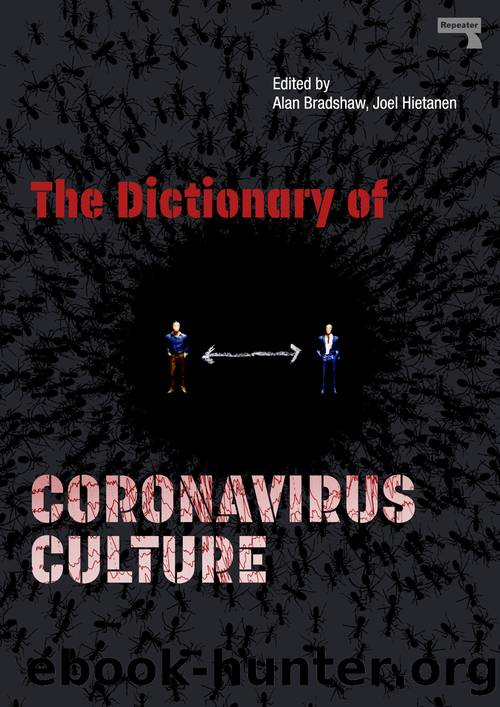
The Dictionary of Coronavirus Culture by Alan Bradshaw
Author:Alan Bradshaw
Language: eng
Format: epub
ISBN: 9781913462437
Publisher: Watkins Media
Published: 2020-11-15T00:00:00+00:00
Søren Askegaard works in the field of marketing at the University of Southern Denmark.
Idleness
Stephen Dunne
Idleness tends to be associated with shortcomings like laziness, uselessness, slothfulness; a character defect with a clear connection to sinfulness. And busyness is seen as the opposite. But actually itâs not quite like that. Bertrand Russellâs famous work In Praise of Idleness argues that idleness could actually be a way towards character development, flourishing, and therefore should be thought in terms of the potential for self-improvement, rather than a denigration of character.
When we look at idleness today, we can see the sinfulness aspect maintained during discussions of welfare scroungers or unemployment; the relegation of the working poor and the non-working poor. Leisure is different. Whereas idleness is associated with sinfulness, leisure is seen as a right and an entitlement. Itâs to do with license and permission and the separation between work and free time. So already we see these two words close enough to one another, but with big differences in the nuance.
Norbert Eliasâs Court Society has a lengthy discussion of Thorstein Veblenâs ideas of conspicuous leisure and conspicuous consumption. Elias is very interested in the Palace of Versailles and the etiquette of activities that, to the outsider, seemed incredibly trivial, like the fifteen different knives and forks, each of which has a function. Elias would say that having free time doesnât mean you succumb to idleness but that it becomes a conspicuous issue. You must demonstrate your class position within the courtâs society through incredibly subtle but nevertheless highly regimented expressions. You need to know what your place is and this informs how to stand, how to touch your face, how to speak, how to address people. And that does not come naturally. To be socialised into the courtly setting is to become habituated in seemingly trivial but absolutely crucial ways.
The behaviours of the contemporary chivalrous male were off limits and driven underground and so we get these subtle readings of the unspoken, nods of the head, the wrinkling of the brow. It makes sense that these things will be observed. This remarkable attention to the unspoken, Elias says, is produced in the context of a courtly society where appearances have to be managed. Leisure is the starting point for all that, and leisure is absolutely not idleness. On the contrary, they are managing each and every aspect of their daily lives in accordance with an unspoken but very apparent set of ideals. So the leisure class for Veblen and Elias is anything but lazy. All this stupid stuff takes on massive significance because thatâs how you compete; you establish your identity through these remarkably trivial things.
Veblen goes right back to the Ancient Greek notion of a free person who did not have to engage in productive activity and could go down to the agora and debate with other people. Slaves did the work so that free people could have their minds on higher things. As history moves forward, this non-productive life becomes associated with
Download
This site does not store any files on its server. We only index and link to content provided by other sites. Please contact the content providers to delete copyright contents if any and email us, we'll remove relevant links or contents immediately.
| Anthropology | Archaeology |
| Philosophy | Politics & Government |
| Social Sciences | Sociology |
| Women's Studies |
Cecilia; Or, Memoirs of an Heiress — Volume 1 by Fanny Burney(32558)
The Great Music City by Andrea Baker(32018)
Cecilia; Or, Memoirs of an Heiress — Volume 2 by Fanny Burney(31956)
Cecilia; Or, Memoirs of an Heiress — Volume 3 by Fanny Burney(31941)
We're Going to Need More Wine by Gabrielle Union(19046)
All the Missing Girls by Megan Miranda(16026)
Pimp by Iceberg Slim(14506)
For the Love of Europe by Rick Steves(14121)
Bombshells: Glamour Girls of a Lifetime by Sullivan Steve(14075)
Talking to Strangers by Malcolm Gladwell(13370)
Norse Mythology by Gaiman Neil(13363)
Fifty Shades Freed by E L James(13240)
Mindhunter: Inside the FBI's Elite Serial Crime Unit by John E. Douglas & Mark Olshaker(9342)
Crazy Rich Asians by Kevin Kwan(9292)
The Lost Art of Listening by Michael P. Nichols(7506)
Enlightenment Now: The Case for Reason, Science, Humanism, and Progress by Steven Pinker(7313)
The Four Agreements by Don Miguel Ruiz(6765)
Bad Blood by John Carreyrou(6621)
Weapons of Math Destruction by Cathy O'Neil(6279)
